Step 1
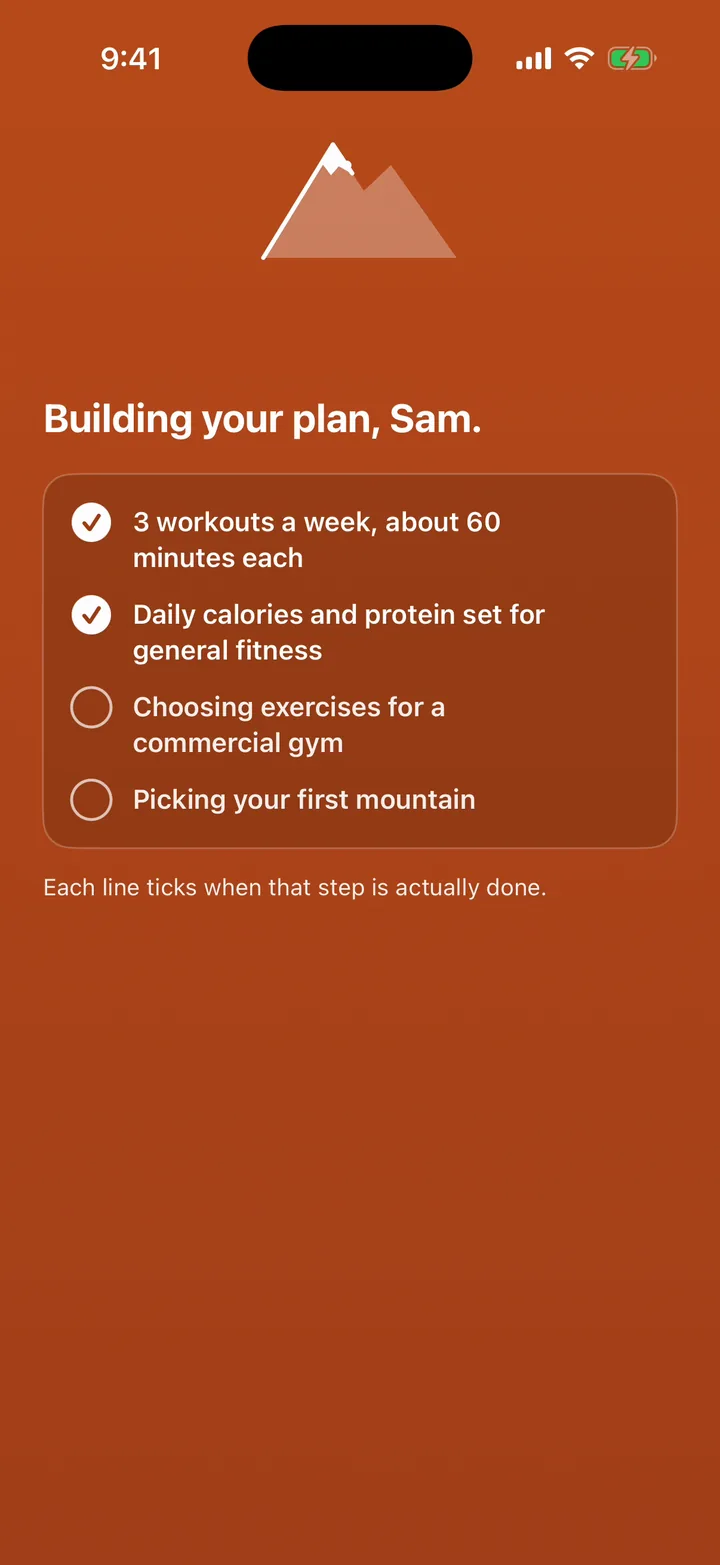
Two minutes of questions.
Your goal. How many days you can train, and for how long. Where you train and what you have: a full gym, a home gym, dumbbells and bands, just bodyweight, or a hotel gym. Any injuries or limits you want planned around.
Your coach reads it back to you, then builds the plan. Each line ticks when that step is actually done.
Step 2
Your first workout is ready.
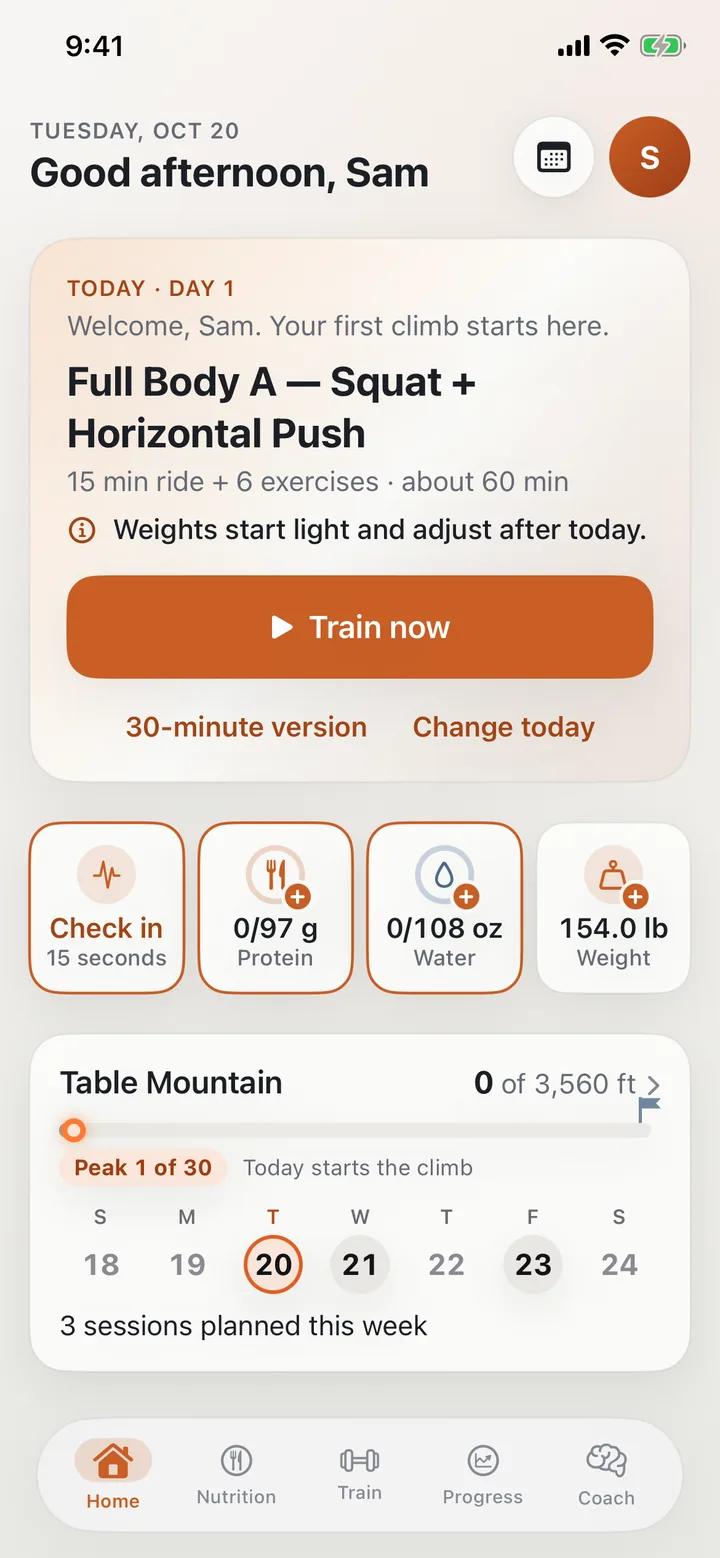
The plan lands on Home with today's session and the week ahead. On day one, weights start light on purpose, then adjust after your first sets.
Short on time? There's a 30-minute version. Somewhere else today? Change today, and the session is rebuilt for what you have.
Step 3
Every set has a weight.
Each workout starts with a warm-up built for that day's lifts. Then every set opens with a target: the weight, the reps, and the plates or dumbbells drawn for it.
- Plates per side, on your own bar: 45, 35, 20 or 15 lb, or a metric bar.
- lb or kg for each exercise, for gyms that mix both.
- Only steps your equipment can actually load.
Step 4
Rate the set. The next weight follows.
After each set, you say how it felt. Your coach does the rest:
- Easier than planned: the weight goes up by a step your equipment can load.
- On target: hold the weight until you own the reps.
- Hard, or missed reps: it holds or comes down.
- First time on a lift: it starts light.
Tap Why? on any weight to see the call: last weight, next weight, hold or go up, and how confident it is.
Step 5
A 15-second morning check-in.
Five questions: sleep, fatigue, stress, soreness, and any pain or limitation. A low score makes today lighter by itself, with fewer hard sets. A good score means train as planned.
Skip it when you're in a hurry. Your plan still works; it just knows a little less about today.
Step 6
Say when something hurts.
Flag pain during a set. That exercise stops, and you choose a pain-free replacement, skip it, or end and save the workout.
The plan adapts to avoid aggravating the area, and that lift's load won't go up until you've had two pain-free sessions. Your coach never asks you to push through pain.
Step 7
Life happens. The week adapts.
- Missed a workout: the rest of the week is rebuilt. Missed work isn't piled onto other days.
- Want different days: move a workout, or change how many days you train.
- Traveling: plan for limited equipment, or train at home today.
A day counts as on track when you do your planned workout or meet 3 of your daily goals, and one free miss a month keeps your streak.
Step 8
Nothing hidden.
The Coach tab explains why your plan looks like this, and keeps a history of every change your coach made to it and why. Ask what your sets decided, and it shows you.
Your plan and its changes are worked out on your iPhone. Nothing is sent to us.